
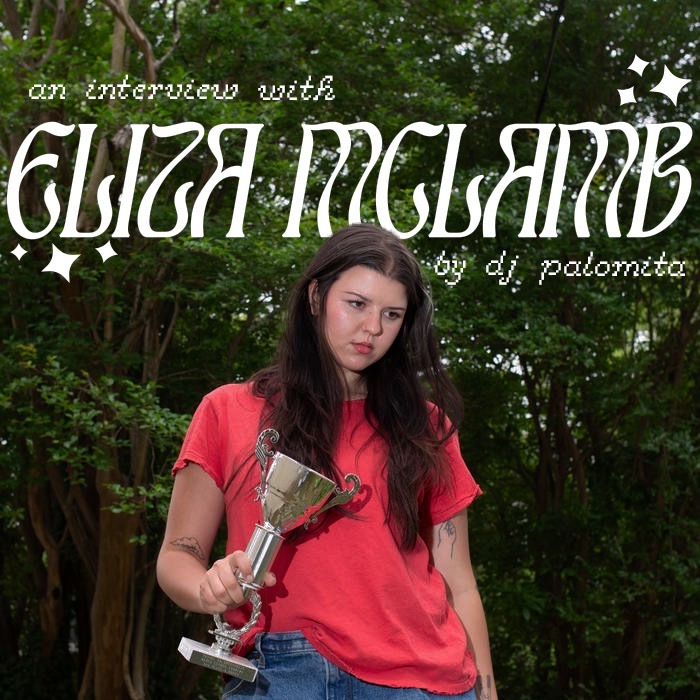
Sofia Tovar: I'm sitting here with Eliza McLamb, right before the October 24th show. So, this is your second time playing through the album live?
Eliza McLamb: Yeah, true.
ST: But we're in North Carolina now.
EM: Yes, we are.
ST: You’re from North Carolina, what does it mean to play shows in North Carolina? Does it feel different?
EM: It feels great. The North Carolina shows are always my favorite shows on every single run. The energy is just really nice.
[Someone walks by on the staircase]
EM: Honestly, should we just do it in the bathroom?
ST: Yeah, that would be good.
[brief intermission moving to the bathroom]
ST: It's like a bar bathroom conversation.
EM: Totally.
ST: Okay, so follow up question to that. How do you see North Carolina as influential to your writing, your music, etc.?
EM: Well, I really loved growing up around the forests and the creeks. It didn't really register to me that not everybody grows up around greenery until I moved to L.A., and I was like, oh my God, you guys don't have as many trees as we do. And so, I definitely think that sort of grounded feeling is something I'm always trying to chase, for sure.
ST: Yeah, I totally get that. Do you have a song from the album that you're most excited to perform today?
EM: I really like Better Song. That's my favorite one to perform.
ST: That’s the opener, right?
EM: Yeah.
ST: I loved listening to that one. That was great.
EM: Oh, thank you.
ST: Your debut album was very personal in many ways. Do you find that challenging to perform live in any way, or to share with people?
EM: Yeah, honestly not really. I think because part of the way I was dealing with what I was reflecting on was transmuting it into the arts. So, the processing has sort of already been done by the time I'm performing the song. So, I don't really find it challenging to perform the songs, which is great. Easier for me.
ST: So recently, you've gone through a lot of changes. You stepped away from the Binchtopia podcast and moved to New York. Has that changed your creative process at all, or made you think differently about it?
EM: Yeah, definitely being in a big city that's very densely packed was really good for me. I think I got a little in my head when I was in LA and wasn't around people as much. And it was really nice to land back in New York where it's kind of impossible to only think about yourself because you're constantly reminded that other people are around you.
ST: Do you have any advice for young writers or musicians?
EM: Yeah, I would say, don't stop yourself from something you haven't been told “no” about. I think a lot of times I got it in my head that some opportunity was not available for me, or some sort of thing I wanted to do or place I wanted to be just wasn't going to happen; The only way to ensure that it never will happen is to believe that. But I think just take bigger swings, take bigger risks because it's worth it, and you'll never know what happened if you didn't do it.
ST: Yeah, might play awesome shows and stuff.
EM: Yeah!
ST: Do you have a favorite lyric on this album? Or a favorite song for the lyrics?
EM: Ooh. Good question. I really like the second verse of “Every Year” about the lifeboat and land. Once I wrote that, I realized that it was the thesis of the record, so I liked that part a lot.
ST: And then talking just about what kind of runs this album, there’s this idea of the story, and storytelling. What does that mean to you?
EM: Well, I think it was something for a long time that I thought was the most important thing to figure out -- how to make narrative sense of things that happened to me. And I feel like I did figure that out, and then it created problems for me, where I was like, oh, now I feel married to this narrative that is limiting, as all stories are. So, this record was an exploration of me figuring out how to, like I say, hold the story lightly. It's not that I [must] get rid of the thing that I thought was the narrative for my life -- because we do have to think about time in a certain way -- [but] just how to incorporate it into my life in a realistic way.
ST: Yeah, like you don't have to live a set story.
EM: Yeah, totally.
ST: If you could choose any place in the world to write your next album or next piece of work, where would you go?
EM: Maybe this is just because I'm reading a book by a Norwegian author right now, but I kind of would love to like camp out in Norway and see what's up over there.
ST: Ooh, wait. I feel like some fire art could come out of Norway.
EM: I know, I kind of think so too. But I wouldn't make pop music up there. I know that's what people like to do in Sweden and Norway, but I would make something else.
ST: Yeah, something special. And then my last question is that if this album was like a little trinket that you could keep in your pocket or your bag, what would it be?
EM: Oh, that's such an amazing question. If the album was a little trinket... Oh, that's so good. I think it might be like a little pair of dice.
ST: Ooh, okay.
EM: I don't know anyone who keeps dice on them but...
ST: People should start keeping dice on them.
EM: If you just want to place a bet on something,
ST: Or give me a number from 1 to 6.
EM: Exactly, it's like tarot cards. You can roll and interpret.
ST: And then like yes or no, if it lands on doubles.
EM: Exactly, then everything's amazing, I guess.
ST: Well, thank you so much.
EM: Oh my God, thank you. And thank you for being okay with recording this in the bathroom.