
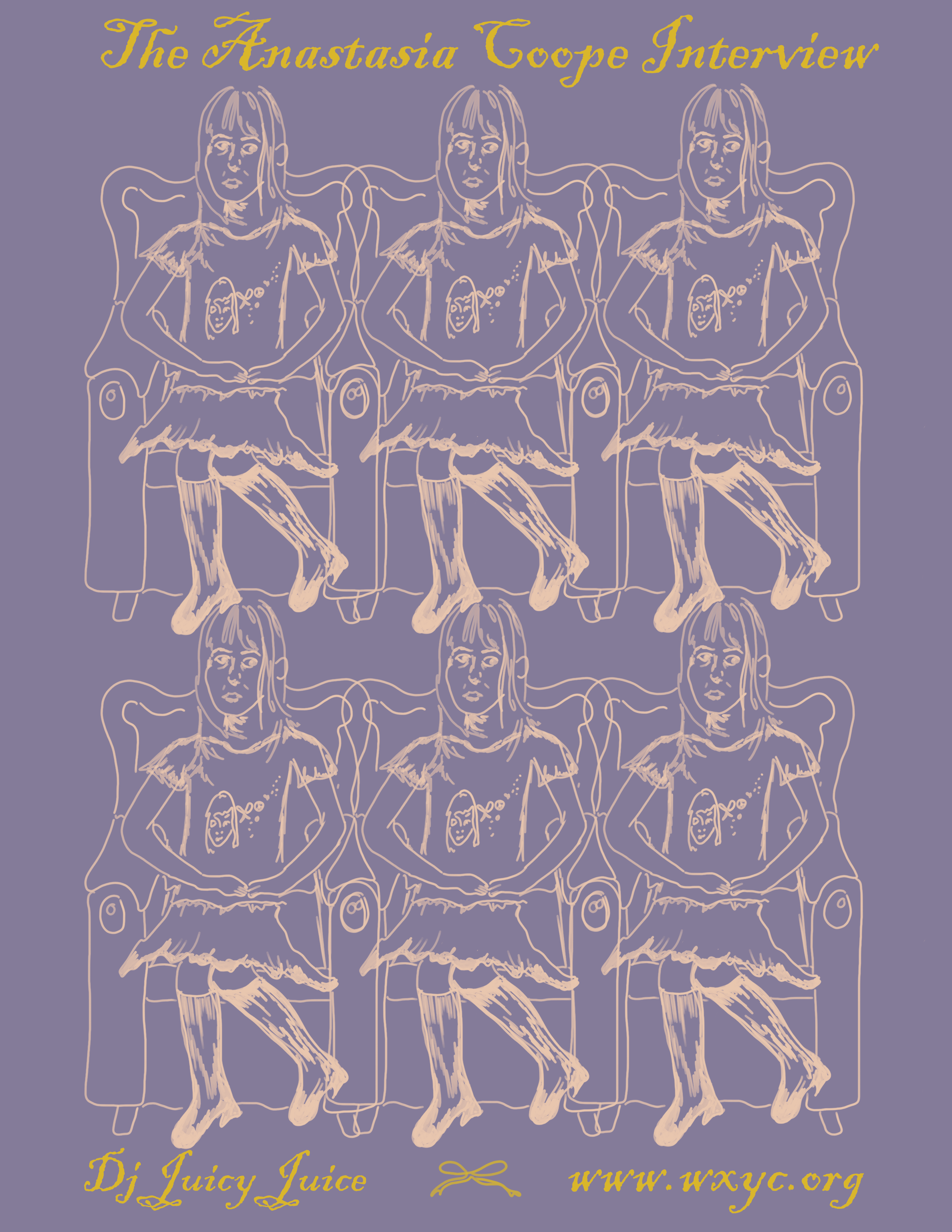
How can a singular person, in their own right, be so incredible? It’s a question Anastasia Coope’s best friend, Mat, asks of her, and a question that I beg when thinking of the artist and visionary. We sing our praises for Anastasia over the merch counter (which also happens to be the kitchen counter) of Rhizome, an arts hub and house-turned-DIY venue nestled in DC’s Takoma Park. Outside, I have the chance to speak with Coope before her headlining performance. She’s been on a tour of the North East, presently with fellow artist Colle, whose performance tonight was utterly captivating, and previously with rising act Lottie’s. Braving the heat and incessant mosquitoes, we discuss musical processes and girl groups in between our conversation about Coope’s music in the past, present, and future. Here is an abridged transcript of our conversation.
KG: We’re here at Rhizome, it’s the 7th of July. I’m Kate Golden, and I’m here with Anastasia Coope.
I wanted to start by talking about your musical background, because I read that you have a Martin (guitar) that belonged to your mother, and you didn’t start to explore [playing] music until later on. Was it something that you grew up around and had the idea of dabbling in, but it didn’t materialize until later in life?
AC: Yeah, I feel like I had a general interest, but it was not something even in the top ten of my interests in childhood. I don’t think I had any particular amount of exposure to music. My parents would play CDs in the car, but other than that, there wasn’t very much in my childhood that was formative musically. It took until I was sixteen to probably realize it was an interest of mine, and then it happened pretty fast, and I realized my parents had exposed me to a fair amount of music by proxy.
KG: And you started as a visual artist, so when you began to dive into music, did you feel you were able to concurrently work on the two (mediums)? Did one inform the other?
AC: I feel like they’re happening at once because it’s more about trying to correctly display whatever vision is occurring, whether it's auditory or visual, I don’t think it changes that much. It’s whatever my set of ideas at the moment are, I feel like it can equally be portrayed in either.
KG: Whichever medium the idea fits into best.
AC: Yeah, and I’m cycling everything through the same set of judgments, so whatever I think is important or impressive about either medium, it collides into an overarching taste. At any time, I feel that I’m trying to make the exact taste I have at that time.
KG: Okay, and I wanted to ask, do you think the circumstances or the events of your life, or even in that specific moment when you’re writing, influence your subject matter? I read that you had started writing during quarantine, and I feel that there are themes of isolation from society seeping in, especially regarding gender roles and expectations.
AC: Sometimes, I feel like the answer is no. Subconsciously, but never consciously. Sometimes I feel like it would be cool if I used this idea here, or the name of that person there. But I’m never like “This situation is happening right now, and I want to write about it.” That’s rare.
KG: My next question is about the process of songwriting. Do you sit with a song until you feel it’s done, or that it’s entirely complete, and move onto the next one? Or do you work on multiple songs simultaneously, adding layers and elements as time goes on until the collective album or EP is done?
AC: Not with (Darning Woman), but with any music I’ve worked on since, yeah. I never finish songs in a sitting, but in the first moments of working on a song, when I’m writing and recording the first ideas of the melody, and the first idea of instrumentation, that is always the point from which I judge if I want it to be a song. If it doesn’t happen right away and catch my interest, I will never go back to it, unless one day I go through all of my vaults and reassess. But, I think I will have a 25-second beginning of the song, and then I generally know where I want it to go because I’ll have the aesthetic vision down in those twenty seconds. But, a lot of the time, I’ll start with a loop and twenty seconds of music and vocals, and I’ll move on to the next thing because I’ve created the skeleton of the song.
KG: So, it’s not super thought out, but there is some intention being put in of whether or not it will pan into an actual recording.
AC: Yeah, I also feel like I always start with hooks rather than a verse-chorus-verse. I feel like it's a chorus-verse-second verse. So, if the first chorus that I open with is catchy and interesting to me, then I know it’s strong enough to build around.
KG: That’s how I feel with (literary) writing, I’ll start with a statement, something to grab your attention, and work from there. If I don’t feel confident about that, I won’t proceed.
*brief intermission for a greeting from Colle*
KG: I want to ask you about your musical intentions. I’m curious about the process of piecing together a collective album. Do you go into the process knowing “This one is going to be a single,” or “This one is going to start the album, and this one is going to end it.” Do you have an idea going into recording, or does it come at the end of the entire recording process?
AC: It varies every time. I just finished a new EP, and for that one, I wrote all of the songs in nine days in the studio that I was recording in; it was just a friend’s space, so that wasn’t a scenario where I had songs and titles for songs before going into the actual recording process; I just came up with everything on the spot. In that moment, it was like “I do the first bit of this song” and then “this is the opener.” The opener and closer are a bit easier to figure out, because those are thematically different, you know, the opener and the closer. But everything else in the middle, for the most part- probably about seventy percent of it- it’s all trying to be some sort of pop song or functionally [like one] in the scope of the project. So, the singles are the ones who settle with the dust, later. A song can be good, but it takes until it’s done to know how to think about it commercially.
KG: Is it relative to the other songs, as well? Which one stands out the most?
AC: Kind of, yeah. I think I have made some single decisions where it wasn’t the song that could be most popular, just because it felt like it could establish (the release) more correctly, but for the most part, you just have to do that. The world is too hard financially right now to just make the single the least catchy one. So, it is “What do I think could be the most commercially successful?” With the next record I’m doing, I have the songs written, I have the titles. I know what the songs are and what the body of songs is like, but I’ll have to record them before knowing what will turn into pop songs.
KG: And the order of the tracks?
AC: Yeah.
KG: I was gonna say, “Return to Room” felt like the perfect ending (to Darning Woman), and I was really happy with the placement of the track. I resonate with the line “I will sleep one more time / Next to who I hurt in younger years”. It also felt like a contemplative track, leaving a lot of questions unanswered. Going along with that, are you going to carry on the themes and sounds of Darning Woman into your next release?
AC: There are some things that I haven’t shaken. I’ll obviously be using vocal layering and the voice a lot, because that’s just the way I think.
*brief intermission for a mosquito attack*
AC (cont.): I think a more similar method of thinking is the opener and closer of Darning Woman is maybe more accurate of a descriptor for what I’m doing now. But, I don’t know, it’s pretty different.
KG: Similar processes, but a different sound and set of themes?
AC: I’ve also grown a lot since those recordings. A lot of those recordings are probably the first songs I ever wrote and worked on for a while. I had to get rid of some ideas that I don’t like anymore.
KG: Did some of them precede “Norma Ray” and “Seemeely”?
AC: Yeah, like “Woke Up and No Feet” was before. Or around the same time.
KG: But it ended up being released later?
AC: Yeah.
KG: My next question is about collaborations. So, you worked on Cemetery Classics with Moon Diagrams. You’ve toured with artists like Kate Bollinger, whom I love. Are there any future collaborations coming up? Or who would your dream collaboration be?
AC: Dream collaboration? I have no idea. But Moses, whom I sang on Cemetery Classics for, needed a vocalist for most of those songs, and I wanted to do it.
KG: He’s a drummer, right?
AC: Yes, and he has drummed on [my] newer songs. I don’t know, out of all of the people I do know and friends I’ve collected from, he has done the most collaboratively. He worked on the upcoming EP. But, dream collaborators? I live with a bunch of people, like six people, and sometimes I think it would be cool [to act] like old producers, such as Joe Meek, who would produce people’s songs who were kind of amateurish musicians and then apply all of his skills and aesthetic sensibilities to uplift them. That’s not a diss on my roommates, but most of them are not musicians. Roommates and friends I would want to collaborate with by sort of doing seventy to eighty percent how I’ve written something and seeing what they do.
KG: I wanted to talk about your music videos next, and the album art. On Seemeely, it seemed like the design was mostly done by someone else. It was the Tough Sun and Seemely (release). But on the more abstractly painted cover…
AC: I did that one! And the seven-inch cover, I sort of had the layout for what I wanted it to be, and my friend brought it into Photoshop and finished it with her vision.
KG: For Darning Woman, I loved the cover.
AC: Thank you, that was the label it was released on, their in-house design team. They were like, “Use them,” so I did. I pretty much just took the photo. I edited the photo to be sort of the general features, and then I was like, “Can you put this photo on a blue background, like this picture, and give my face the glow of this lamp I saw?” and then they did it. I’m glad I didn’t have to do it myself.
KG: With your music videos, I think it was mentioned in the Perfectly Imperfect newsletter that you use iMovie for them.
AC: The ones that I did myself, yes. On the other ones, people did other things.
KG: Do you think that you would ever cross into filmmaking or video design?
AC: I really want to, but I feel that I don’t want to do anything half-a**ed. I would really need to commit. I think about this sometimes. I would want to direct a movie that was… It’s really easy to just want to do visual things, which I do all the time by myself, but I want to make a movie…
KG: Following a narrative.
AC: Yeah! It would be really hard. I really want to figure that out, but it’s like a thirty-six-year-old activity for me.
KG: It’s in the future.
AC: Yeah, yeah.
KG: This is probably my last question. Something I really admire about you is your love for a girl group, like The Shangri-Las. I noticed some influence on your previous releases. It’s hard, so don’t feel any pressure to immediately answer, but who would you include in your ultimate girl group?
AC: That’s a really good question. One of my three best friends, Mat, who’s doing my merch tonight, would be in the girl group. Then I think I would go to various countries and try to meet people, and then scout them based on all of their features. I would ask them to sing. I would ask them to improvise. Maybe two from my travels, Mat, and then just me. But I would become a different character. I want to do this too. I eventually want a small choir of six, standing really close together.
KG: Would most of the six be people you pick up from your travels?
AC: Travel, friends, I don’t know. But, the only person I’m sure of right now is Mat.