Gov Ball is a landmark festival in Queens, New York, and year after year it attracts some of the biggest names on the summer festival circuit.
With any festival, there’s always a lot that goes right—but sometimes even more that goes wrong. I should preface that the lineup going into this year was just underwhelming, in my opinion. I’m not a fan of Stray Kids or Jennie, two of the major headliners on my days of attendance.While both artists captivate massive audiences, neither was a major draw for me, which consequently shaped my expectations going into the weekend.
GOV Ball, Almost Famous:
Unfortunately, I was unable to attend the first day of Gov Ball. Missing Baby Keem and Lorde was disappointing, but beyond a handful of artists, there wasn’t much on Friday’s schedule that brought on FOMO.
Gov Ball seems determined to appeal to as many audiences as possible with a vast roster of performers. This approach makes sense from a business perspective, but from an attendee’s vantage point, it makes the festival feel scattered. At times, the lineup felt less like a carefully curated experience and more like several different festivals happening simultaneously. Depending on your taste, that can either be exciting or frustrating.
For me, the weekend ended up being a constant sprint from stage to stage. Gov Ball graciously provided us with media passes, which meant access to the festival's VIP amenities and press lounge. Walking into that space for the first time felt a little daunting. It was a behind-the-scenes world that I had only ever seen through social media clips and music journalism coverage.
One recurring character throughout the weekend was the notorious music critic, Anthony Fantano. Every time I stepped into the lounge, he seemed to be there. Other artists drifted through as well, including Jane Remover, Radio Free Alice, JimmyBoy, and Japanese Breakfast. Seeing these artists casually exist outside of their performances was surreal.
What struck me most was getting a glimpse of how music journalism actually functions at a festival. My social media feeds are constantly flooded with content from festivals, interviews, and publications covering events like Pitchfork and Coachella. Being on the other side of that process—watching interviews happen in real time and conducting some myself—felt both strange and empowering.
For moments throughout the weekend, I felt a little like William Miller from Almost Famous. There were representatives from major magazines, record labels, publicists, and artists all moving through the same space, and somehow I was there too. It was equal parts intimidating and exciting, a reminder that the world of music journalism is much more tangible than it seems from the outside.
WXYC was actually able to secure two interviews, which, as a first-time interviewer, was both exciting and terrifying. To make things more challenging, I was on a solo mission. It was humbling trying to operate a camera, monitor audio, and ask thoughtful questions to artists who have graciously agreed to speak with you.
The first interview was with JimmyBoy, an artist from Berkeley who performed earlier in the weekend. The interview exceeded my expectations. We had a genuine conversation, and I left feeling much more confident than when I walked in. By the time you're reading this, the interview will hopefully be posted—or at least somewhere in the editing process.
Our conversation with Radio Free Alice was slightly different. The band was incredibly kind and generous with their time, but my inexperience as an interviewer quickly became apparent. I relied too heavily on broad, general questions, which left us with a staggering three-minute interview. Looking back, some of the questions had charm, but they weren't intentional enough to spark the kinds of answers that lead to a memorable conversation.
It’s just part of the process. Nobody starts out knowing exactly how to navigate interviews, and every awkward silence or missed opportunity becomes a lesson for the next time. So, to the handful of Radio Free Alice fans reading this: don't worry. I'll come back with better questions next time.
Gov Ball Day 2: Pile of Dirt
Day 2 of the festival—Day 1 for me—was as chaotic as it could be.
Just getting there felt like an adventure. Between three separate trains and buses and a 30-minute walk, arriving at the festival felt surreal. Holding Gov Ball in Flushing Meadows Corona Park gives the entire event a strange sense of scale. The park itself is steeped in history, having hosted the World's Fair, and remnants of that history are still scattered throughout the grounds. Massive structures seem to sit in various states of decay, creating a strange contrast between the past and the thousands of people gathered there for a music festival.
The most striking landmark, appropriately, was the Unisphere—the giant globe that has become synonymous with both the park and the festival itself. Seeing it in person immediately made the festival feel real.
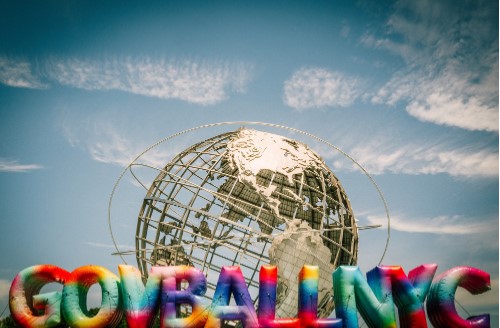 Credit: Rich Fury
The grounds were beautiful. For reasons I never fully figured out, the main walkway was lined with trees wrapped in bright pink fur. It was bizarre, but it worked. The entire setup felt playful and slightly surreal, which only made me more excited to hear the grand display of live music.
The first set on my radar was Jane Remover. They were performing on the smaller Grove stage, positioned on what could only be described as a giant pile of dirt; a detail that would quickly become important.
From the moment the set started to when the mosh pit opened, dust completely filled the air. Every jump propelled another cloud until the entire crowd seemed to be moving through a haze. Everyone was coughing, covered in dirt, yet nobody seemed to care. If anything, it only made people want to jump harder.
By the end of the set, I was severely dehydrated, completely coated in dirt, and approximately one Jane Remover concert happier.
Immediately afterward came Snow Strippers. This time I decided to hang near the back of the crowd because I wasn't entirely convinced my lungs could survive another dust storm. Watching from farther away also gave me a chance to take in the crowd itself. Gov Ball's audience skews surprisingly young. I spoke with former station manager DJ Panda, a New York native, about it. She attended the festival while still in high school, and the more I thought about it, the more the lineup itself felt geared toward that demographic. That's not necessarily a bad thing, although I occasionally felt a little out of place, depending on the set. Regardless, Snow Strippers delivered exactly what I hoped for. Their performance was chaotic, energetic, and impossible not to get caught up in.
Afterward, I rushed across the festival grounds to catch Blood Orange, the artist I was probably most excited to see all weekend. I found a good spot, settled in, and waited for the set to begin.
Then Major Lazer walked onstage.
To any Major Lazer fans reading this, I'm sorry. Once again, they're simply not for me.
At first, I genuinely thought I had gone to the wrong stage. I checked the schedule. I checked the signs. I checked my phone. Nope.
Because of impending weather concerns, Gov Ball had shuffled the schedule, cutting several artists entirely—including Blood Orange—in order to give additional time to artists like Major Lazer and Stray Kids. For me, that was a frustrating trade-off. I understand that festivals can't control the weather. Every large outdoor event has to make difficult decisions when storms are involved. What bothered me was how the situation was handled. Rather than shortening a number of sets to keep more artists on the schedule, the festival seemed willing to remove some acts altogether. Losing Blood Orange was disappointing enough on its own, but it would end up being only the first of several weather-related issues that defined the rest of the weekend.
Gov Ball Day 3: How Soon is Now
Day 3 of Gov Ball arguably had the strongest lineup of the entire weekend. Most importantly for me, Blood Orange had been added back onto the schedule after being cut the day before. It was unexpected, and honestly, one of the best surprises of the festival.
Unlike the previous day, I didn't have any interviews planned. That meant I could spend the entire day doing what I came for in the first place: listening to music.
The first act I made sure to catch was Lexa Gates. I had done a deep dive into her music while preparing pre-festival coverage and quickly became a fan. Her music often samples sounds from the '60s, including songs by Dorothy Ashby and Tyrone Davis. She blends these timeless artists with her own deeply personal lyrics about her life. It felt refreshing and intimate in a way that translated really well to a live setting.
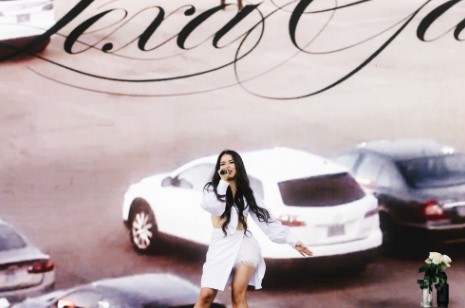 Credit: Paigge Warton
Her set also highlighted something I had been noticing all weekend: the strange divide between General Admission and VIP crowds. Being in VIP came with obvious perks. Better sightlines, more space, and easier access to the stage. What it seemed to lack was enthusiasm. Throughout Gates' set, most of the VIP section seemed completely disengaged. People were glued to their phones, recording entire songs, chatting with friends, or simply standing there. Meanwhile, the General Admission crowd was fully invested—singing along, shouting lyrics back at the stage, and matching Gates' energy at every opportunity. The contrast was impossible to ignore. Tickets for VIP cost a small fortune, yet the people furthest from the stage often seemed to care the most. At one point, Gates even called out the VIP crowd for their lack of energy. Embarrassingly, it didn't seem to change much.
After Gates came yet another round of weather complications.
Slayyyter was scheduled to perform next, but incoming rain delayed her set. In reality, the weather never escalated beyond a light drizzle, but the delay still cut her performance time significantly. By this point in the weekend, weather interruptions had become a recurring theme, and while I understand that safety always comes first, it was difficult not to feel frustrated watching another artist lose valuable stage time. Despite the shortened set, Slayyyter completely exceeded my expectations. I hadn't spent much time with her music beforehand, but her performance immediately won me over. She brought an infectious energy to the stage and made every minute count.
The rest of the day became a strategic waiting game.
Japanese Breakfast and Blood Orange were scheduled on the same stage, so I decided to stay put and protect my spot rather than losing it by wandering elsewhere. It turned out to be one of the best decisions I made all weekend.
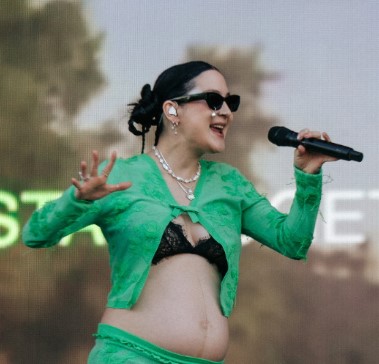
Japanese Breakfast is one of those bands I've mostly experienced through their most popular songs. Despite being a fan, I've never really taken the time to do a deep dive into their catalog. Seeing them live finally gave me a fuller sense of what the band is all about.
 Credit: @okaynicolita
Their set was incredibly playful and fun. Michelle Zauner, who is six months pregnant, looked like she was having the time of her life, dancing across the stage with infectious energy. That joy carried through the entire performance, with the band embracing a lighthearted spirit that made the set feel both engaging and memorable.
After the set came Blood Orange
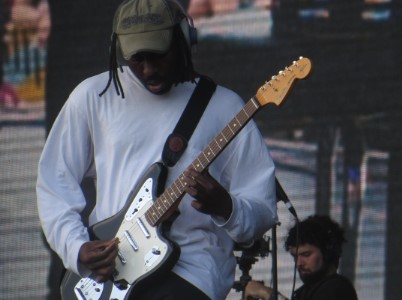
At a certain point, it's difficult to describe a performance without resorting to clichés, but Blood Orange was genuinely incredible. Hearing songs like "Wish," "Best to You," and "Champagne Coast" live hits on an entirely different level. There are some artists whose music feels meticulously crafted for headphones, and others whose music seems to expand when performed live. Blood Orange somehow manages to be both.
 Credit: Julian Swart
Even from VIP, I was fully dancing along, which at that point felt like a rarity in that section. One of the most memorable moments came before the set had really even begun. Dev Hynes walked onstage and, as he has done during several recent performances, opened by playing a solo cello cover of "How Soon Is Now?" by The Smiths. It's one of those things that sounds strange when written down but feels completely natural in the moment. I didn't know I needed to hear a cello rendition of a Smiths song before a Blood Orange set, but now it's something I'll probably remember every time I think about the festival.
Next, came a mad dash across the festival grounds to catch Geese.
 Credit: Rich Fury
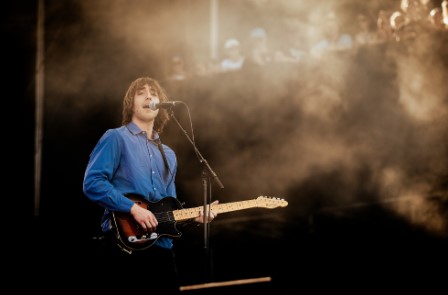
I know the Geese bandwagon is in full swing right now, but I've been on board for a while. This marked my third time seeing the band and my fourth time seeing Cameron Winter perform in some capacity. I know that doesn't earn me much credibility in the ever-growing Geese fandom, but it's enough for me. Maybe this is me being overly protective of a band I love, but the Geese hype machine was very much present in the crowd. In a strange way, it almost made me self-conscious about enjoying the set. There were moments where it felt less like people were there to experience the music and more to participate in the phenomenon of Geese.
The most accurate moment of this was a group of friends all decked out in Geese Merch. I mean the whole 9 yards: hats, shirts, e.t.c. Halfway through the set, a guy mentioned not even liking the band yet wearing their merch head to toe. I don’t mention this to be hateful, but rather to highlight a perfect example of the conversation surrounding the band.
Either way, I had a good time. Geese played a lot more 3D Country than I’ve heard from them before, which I loved.
The final artist on my checklist was A$AP Rocky.
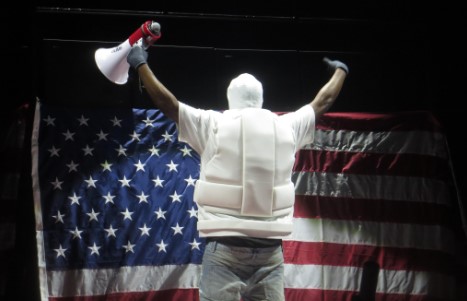
As the festival's closing headliner, Rocky carried an enormous amount of anticipation. It had been five years since he last played Gov Ball, making this performance feel like a homecoming for one of New York City's biggest stars. As the sun began to set over Flushing Meadows Corona Park, the excitement across the crowd was impossible to ignore. Everyone seemed restless, waiting for the moment the set would finally begin. Rocky arrived with all the spectacle you would expect from a headliner. His crew brought out a scaled-down helicopter replica along with an assortment of elaborate stage props that transformed the festival grounds into something closer to a movie set than a concert stage. The set opened with "GRIM Freestyle" as performers dressed as a SWAT team stormed the stage. Within moments, the energy across the park exploded.
"I came to get disrespectful," Rocky announced to the crowd.
Honestly, it was the perfect way to describe the performance.
 Credit: Julian Swart
The set was a celebration of both Rocky's past and future. He balanced fan favorites with newer material, creating a performance that felt like a statement of who he is as an artist right now. Songs like "Sundress," "LVL," and "Punk Rocky" were particular highlights for me. What impressed me most wasn't just the music but the stage production surrounding it. The SWAT-themed performers weren't simply background dancers; they became part of the show’s narrative. Every song seemed to have its own choreography, staging, and visual identity, making the performance feel carefully constructed from beginning to end.
Looking out over the audience was almost surreal. Waves of people moved through the crowd as fans crowd-surfed from one end of the pit to the other. At certain moments, the sea of bodies looked more like an ocean than a concert audience.
More than anything, though, the performance felt distinctly New York.
Rocky wasn't just playing a festival set—he was performing for the city that raised him. That connection was evident throughout the night, both in the way he addressed the crowd and in the way the crowd responded to him. There was a sense of mutual appreciation between artist and audience that made the performance feel bigger than a typical headlining slot. Rocky continued performing right up until festival staff cut off his microphone. It was an abrupt ending to an otherwise triumphant set, but in some ways it felt fitting. He seemed determined to give every last minute he could to his hometown crowd.
Throughout the performance, imagery and messaging connected to his newest album, Don't Be Dumb. On massive screens, visuals repeatedly encouraged the audience to look up, pay attention, and remain aware of the world around them. Whether discussing social issues, personal responsibility, or self-expression, the message was one of engagement rather than complacency.
In a festival weekend defined by weather delays, schedule changes, and missed opportunities, A$AP Rocky's closing set felt like a reminder of why people endure all of that in the first place. It was ambitious, theatrical, deeply rooted in New York, and delivered with the kind of energy that can only come from an artist performing in front of a city that still claims him as one of its own.
GOVBALL: The Overview
Governors Ball was an interesting experience for me. Going solo felt intimidating at first, but throughout the weekend, I met so many interesting people and saw so many incredible artists perform. The weather was a constant challenge, and while the delays and schedule changes were frustrating at times, the festival did an excellent job prioritizing safety above everything else. The staff deserves a lot of credit for keeping attendees hydrated and doing their best to keep the festival running smoothly despite the conditions. In the end, Governors Ball lived up to its reputation as one of New York City's landmark music festivals, and I'm incredibly grateful that I had the opportunity to experience it. It was a weekend filled with great music, unexpected connections, and memories that I'll carry with me long after the festival ended.